
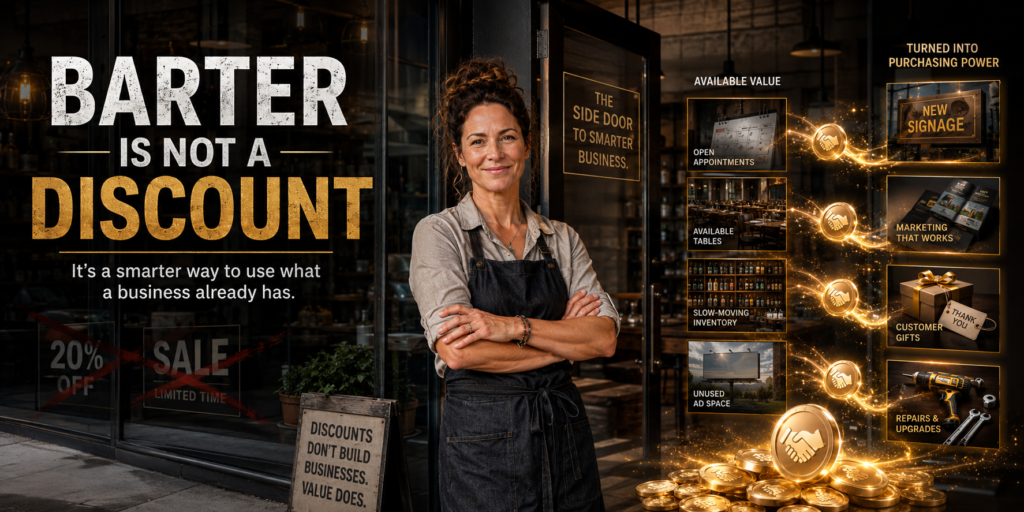
Smart barter protects price, preserves cash, and turns available business value into something useful.
Small business owners have a long memory when it comes to discounts.
They remember the customer who wanted “just a little better price.” They remember the friend-of-a-friend who asked for a favor. They remember the promise of exposure that never turned into sales. They remember the job that looked harmless until it ate up three days, two staff members, and the margin that was supposed to make it worthwhile.
So when someone brings up barter, a good owner may hear one thing:
“Here comes another way to get me to work for less.”
That reaction is not cynical. It is earned.
But organized barter, done correctly, is not the same as discounting.
Discounting lowers the perceived value of what a business sells.
Strategic barter helps a business capture value that may otherwise sit unused.
That distinction is the difference between a weak deal and a smart growth tool.
A discount changes the customer’s expectation
When a business discounts too often, the market learns to wait.
Customers start asking, “Is there a promotion?” They wonder whether the regular price is real. They begin measuring value by how much they can shave off the invoice.
That can be dangerous for small businesses, especially in markets where reputation matters. A restaurant in Royal Oak, a contractor in Livonia, a printer in Toledo, or a service provider in Fort Lauderdale cannot afford to train customers to believe the first price is only a starting point.
Barter works differently when it is separated from the public cash market and handled through a professional trade network.
A business can keep its cash pricing intact while using trade to activate value that may otherwise sit still. That value might be an open appointment, unsold ad space, extra production capacity, available event space, seasonal inventory, slow-moving product, or professional time that can be put to better use.
That is not lowering the value.
That is choosing another channel.
Barter uses the side door, not the front window
A useful metaphor is a storefront.
The front window is the cash market. It is what the public sees. It reflects the brand, the price, the quality, and the promise.
The side door is where smart operators manage opportunity already inside the business: open appointment times, extra inventory, available rooms, unfilled tables, unused production time, unsold advertising space, service capacity, or products that deserve a better path than sitting still.
Barter belongs at that side door.
It does not need to announce to every cash customer that the business is cheaper. It gives the owner a controlled way to put available value to work.
A restaurant may use open tables, catering opportunities, or event space to earn TradeDollars. A wellness provider may turn open appointment slots into purchasing power. A retailer may move products that are paid for but moving slowly. A contractor or service company may use available capacity to create value through the network.
Those are operating decisions.
Not discounts.
The strongest trade decisions have purpose
A business that treats barter casually can become frustrated.
A business that knows what it wants trade to accomplish can use barter with confidence.
That is why good barter begins with purpose.
Which products or services make sense on trade?
What value is available inside the business?
What costs must be protected?
What type of TradeDollar spending would make the trade worthwhile?
Which business goals could trade help support this month or quarter?
These are the same kinds of questions owners already ask about staffing, scheduling, pricing, and inventory. Barter should not be treated as a separate universe. It should be managed with the same practical discipline.
One retailer used barter by selecting inventory that had been sitting longer than expected. The business traded products that were taking up space and attention, then used the TradeDollars for signage and customer gifts.
That was not a markdown.
It was a conversion.
The real enemy is waste
For many small businesses, the problem is not that they lack value.
The problem is that some of their value is not being used.
An open appointment holds value. An unfilled table holds value. Unsold inventory holds value. Available production time holds value. Open service capacity holds value.
Barter is a way to catch some of that value and turn it into purchasing power.
This matters in today’s economy because owners are already stretched. Employee costs, vendor costs, insurance, rent, utilities, and materials do not wait patiently for the next strong month. When a business has available assets, those assets deserve attention.
A business owner does not have to cheapen the company to use barter.
The better move is to identify where value already exists and put that value into motion.
TradeFirst gives barter a professional frame
Casual trade can become awkward quickly.
Two owners may agree on a swap, then discover the value is not equal, the timing is inconvenient, or the expectations were never clearly defined.
A professional exchange creates a better frame.
TradeFirst allows members to earn TradeDollars from one business and spend them with another. The transaction is tracked. The network is broader than a one-to-one swap. Broker support helps members think through opportunities and use trade more strategically.
That frame gives barter credibility.
It also helps owners avoid the feeling that they are simply doing favors.
Barter should make a business feel stronger, not smaller
A good barter strategy should leave a business owner feeling more in control.
More control over open capacity. More control over cash pressure. More control over inventory. More control over growth investments. More control over how value moves through the company.
If barter feels like pressure, confusion, or margin erosion, something is wrong.
If barter helps a business use capacity that would have sat open and spend TradeDollars on meaningful needs, it becomes a serious tool.
That is the message small business owners deserve to hear.
Barter is not about working for less.
It is about wasting less.
This post expands on previous post, Barter as a Growth Strategy.
Next read: The Hidden Value Sitting Inside Empty Slots, Open Capacity, and Slow-Moving Inventory.