
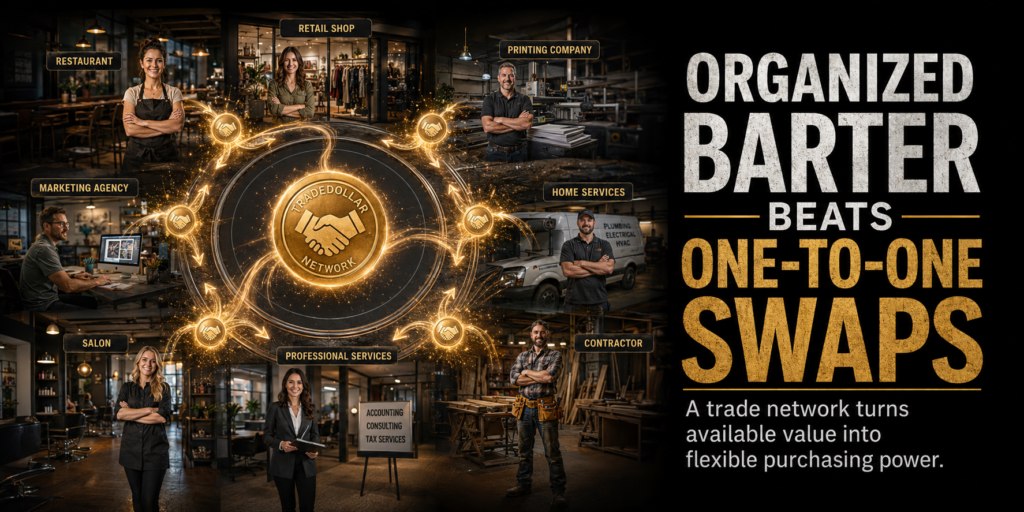
A handshake swap can solve one problem. A professional trade exchange can create ongoing purchasing power across a business community.
Most business owners have done some kind of informal trade.
A photographer trades headshots for a website update. A restaurant caters lunch in exchange for printing. A contractor fixes something for a vendor who provides another service. Two owners know each other, trust each other, and agree that the value feels close enough.
Sometimes that works well.
Local business communities have always been built partly on relationships, favors, referrals, and practical arrangements. There is nothing wrong with two good businesses helping each other solve a problem.
But there is a reason casual barter usually stays casual.
It is hard to scale.
The problem with one-to-one swaps is the perfect-match problem
A direct swap only works when both businesses want what the other offers at the same time.
That is a narrow doorway.
A printer may need accounting help, but the accountant may not need printing. A Fort Lauderdale wellness provider may want restaurant certificates for staff, but the restaurant may not need wellness services right now. A Toledo contractor may want advertising, but the media company may not need contracting work. A Metro Detroit retailer may have products to trade, but the business they want to buy from may not need those products.
The value is there.
The match is not.
Organized barter widens the doorway.
Through TradeFirst, a business can sell to one member, earn TradeDollars, and spend with another member. The buying and selling do not have to happen between the same two businesses.
That flexibility is the foundation of professional barter.
A trade exchange is more like a roundabout than a two-lane road
A one-to-one swap is a straight road between two businesses. If either side does not want to travel that road, the deal stops.
An organized exchange is more like a roundabout. Value enters from one business and can exit toward another. It keeps moving through the network.
A restaurant earns TradeDollars from member dining. The restaurant spends with a sign company. The sign company spends with a cleaning service. The cleaning service spends with a printer. The printer spends on dining.
No single pair had to match perfectly.
The network created movement.
This is where barter becomes more powerful than a favor.
Organized barter turns available value into flexible purchasing power
One-to-one swaps are limited by the needs of two businesses.
A trade exchange is powered by the needs of many.
That matters because most businesses have value available in different forms. A restaurant may have dining or catering opportunities. A retailer may have slow-moving product. A service company may have open appointment times. A printer may have production capacity. A venue may have space. A professional firm may have project availability.
Through TradeFirst, that value can be sold to one member, converted into TradeDollars, and spent with another member.
A restaurant can earn TradeDollars from open dining or catering opportunities and spend with a printer. A retailer can move slow-moving product and spend on signage. A service business can turn open appointment times into purchasing power and use it for marketing, cleaning, gifts, or professional support.
The network keeps value moving.
Structure protects relationships
Informal swaps can get uncomfortable.
Was the value equal? When will the work be done? What happens if one side delivers quickly and the other delays? What if the scope changes? What if one owner feels the other got the better deal?
Small business owners already have enough delicate conversations. They do not need a barter arrangement to strain a relationship.
A professional trade exchange creates clearer structure. TradeDollars are tracked. Member transactions happen inside a system. Broker support can help members identify opportunities and navigate expectations. The exchange creates a business frame around barter.
That structure does not remove the human side.
It protects it.
Scale creates usefulness
A one-to-one swap may be useful once.
A network can be useful all year.
That difference matters when businesses have recurring needs: printing, marketing, dining, repairs, staff gifts, customer appreciation, travel, wellness, events, professional services, maintenance, and more.
A Southeast Michigan business may earn locally and spend with another member across the region. A Toledo-area business may use trade to build relationships beyond its immediate circle. A Fort Lauderdale-area business may use barter to make better use of available capacity and connect with other service-driven companies.
The value grows as the network grows.
That is something a casual swap cannot easily provide.
Broker support helps owners use barter wisely
Many business owners like the idea of barter but do not want another thing to manage.
That is fair.
Owners are already wearing too many hats: sales, HR, finance, operations, customer service, marketing, maintenance, and sometimes snow removal or last-minute delivery driver.
Broker support helps make barter easier to use.
A broker can help a business think through what to offer, what other members may need, and where TradeDollars can be spent strategically. That guidance helps prevent barter from becoming random.
The goal is not simply to trade.
The goal is to trade well.
Casual swaps still have a place
This is not an argument against every direct trade.
Business owners will always make relationship-based arrangements. A trusted swap between two businesses can make sense.
But when barter becomes part of a growth strategy, the business needs more than occasional convenience. It needs reach, tracking, flexibility, support, and a marketplace where value can keep moving.
That is what organized barter provides.
A swap may solve one problem.
A trade exchange can become part of how the business operates.
TradeFirst makes barter feel less like a side deal and more like a business tool
The word barter can sound informal because many people have only experienced it informally.
TradeFirst changes the frame.
It gives business-to-business barter a professional home: a network, a system, TradeDollars, broker support, and a community of businesses that understand how trade can support cash conservation, marketing, operations, employee appreciation, and owner value.
That is the authority message worth reinforcing.
Barter is not just something two owners do when cash is tight.
Organized barter is a way for business communities to create value together.
For small businesses in Southeast Michigan, Toledo, Fort Lauderdale, and beyond, that idea deserves more attention.
Because when value moves through local businesses, more businesses have a chance to move forward.
This post builds on previous post, Barter as a Growth Strategy.